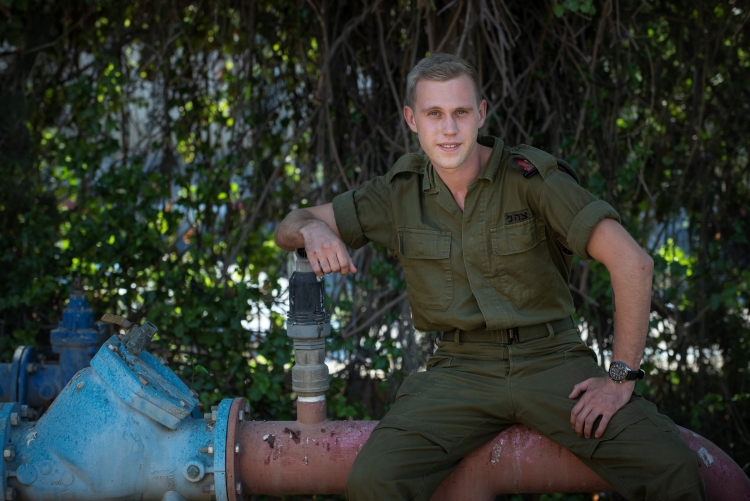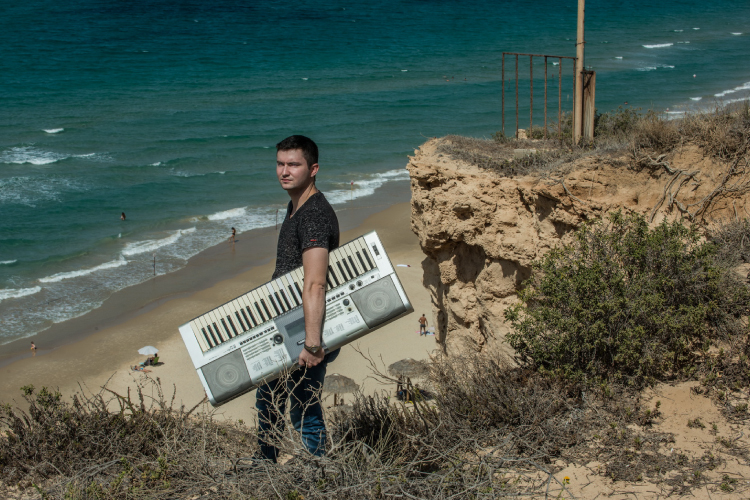
It’s a story about a soldier who, during his service, begins and completes a conversion process. “I can’t count the number of times I’ve been asked what it’s like to undergo a conversion process and it’s not something you can explain in 10 minutes, so I decided to lay it all out in 240 pages,” Sergey Stolbov explains.
“The book follows every step of the process and is told from my point of view: how I felt, what my opinions were, and how they changed.”
Let’s go back to the beginning. Where were you born?
“I was born in Irkutsk, Siberia, in 1992. My mom is Christian and so is my dad, but his father comes from a totally Jewish family. My grandparents lived in another city and we didn’t visit them very often. When I was six and a half, my dad visited his older brother, who had already moved to Israel and was living in Netanya. He was really impressed by Israel and the next time he visited he took us all with him. Then my mom also fell in love with the country and they announced to us that it was a done deal: ‘We’re moving to Israel!’”
The Stolbovs arrived in Israel that same summer. “It was mid-August and two weeks later I was already starting first grade, without speaking any Hebrew. They threw me in at the deep end. It was hard, also from a social perspective, but I gave it time. Within 18 months I’d mastered Hebrew. Little by little I got to know the culture. The first time I tasted falafel, I loved it. The whole buffet culture, where people sit outside and eat, was unheard of in Siberia, and Israel’s very open atmosphere influenced me and my family. I love Israeli food, and from all my other preferences you’d think I was totally Israeli. Music, for example. I really enjoy Mediterranean music.”
Do you remember when you first heard that genre?
“One time, the whole family went bowling and Kobi Peretz’s ‘Balbeli Oto’ was playing. I already understood the lyrics at that point and I really connected with his Israeliness and Mizrahiness. In Siberia, most songs are actually long texts accompanied by a melody – the singers do less singing and more reading. I like that Israeli singers hit really high notes, with a trilling style. What really intrigues me, as a music student, are the arrangements that combine Israeli music with Russian music.”
Judaism only caught Sergey’s attention in the army. “Until then, I thought that someone’s religion was only about what they believed in. During basic training, someone asked me to make up a minyan for prayers. They said it was a mitzvah and I joined in. But right before I was about to go inside the synagogue, they asked me, ‘Wait, are you Jewish?’ and I didn’t know what to say. It wasn’t until I said that my mom isn’t Jewish, and they said, ‘Sorry, you’re not Jewish, you can’t make up the minyan’ that I got the idea.”
Did you start the conversion process right away?
“No, I kept putting it off. Then I got into a relationship with a girl whose family wouldn’t accept me and it all blew up and we broke up. I finally realized I couldn’t put it off any longer and started the Nativ Military Program.”
And how did that go?
“I arrived with one goal in mind. It was clear to me that I wasn’t there to debate or examine anything. I was super motivated. I really enjoyed the experience. I discovered a lot of things. I learned about Shabbat, about kashrut. I started to understand why certain blessings are said. Shabbat was something that really worried me, because of all the things you can’t do, but my host family was lovely. They got me to experience it for myself and see the benefits. I went to synagogue with the father of the family, we said all the prayers, and I even ate chraime too.”
Were there any problems?
“When I had my first meeting about the Conversion Court, it was tough. I was told that I wasn’t at a high enough level and would have to work hard to convince the rabbis. It made me doubt myself, but at the same time it gave me the motivation to continue. It was a very serious period. During seminars A and B, I got to be the cantor the most times because it was important to me to practice as much as possible and go to the Conversion Court feeling really confident.”
Did that work?
“No. I didn’t pass the first time around. It hurt and for a little while I lost my passion and enthusiasm. But in retrospect I’m glad it happened. I think the good feeling I got when I passed the second time was due to the fact I overcame the obstacle and the depression that followed. It was a very powerful moment in the process.”
Today, Sergey shares these experiences with students from Nativ’s Military Program. He speaks to them as part of what’s called a Convert Panel. “When I was sitting on the panel as a soldier, a yeshiva student came to speak with us, wearing a kippah and tzitzit. We really freaked out. It’s important for soldiers to see that all kinds of people have completed the process. I represent kind of a middle ground – I’m observant but I don’t wear a kippah. I speak to them at their level and try to show that it’s not all black or white. No one can judge them – they need to embrace their own truth.”
And soon his book will be published.
“I think that many soldiers in Nativ’s program will find it interesting. We’ll start by selling it online and then it’ll also be in stores. I called it ‘Segev,’ because that’s the Jewish name I chose for myself during my conversion process. Segev means grandeur, majesty, splendor – and that’s the sense I was filled with during the process. Most people still call me Sergey but I answer to both names.”