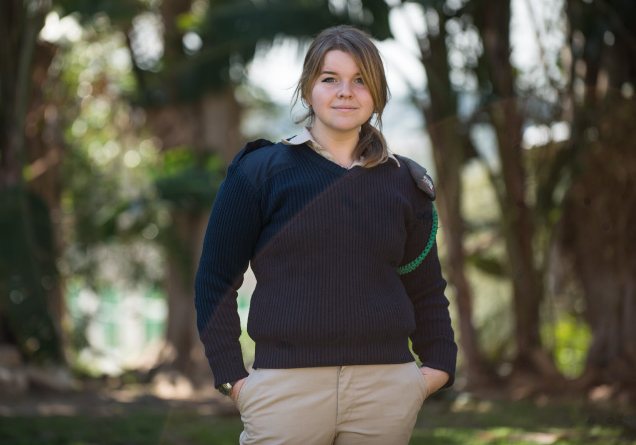
Anya Gordienko came to Israel when she was 16 as part of the Naale program, which enables Jewish teens from around the world to attend high school in Israel. Three years later, she enlisted. “I decided to take the Nativ course to better understand who I am, where I am, and what I want to do in the future,” she says. “I was only hesitant about the timing of the course. It wasn’t easy to find the right time to be away from my unit for almost two months.”
Why?
“I’m a company commander in the Air Force and we had a severe shortage of company commanders, so they didn’t really want to let me go – and I was also worried about leaving my soldiers alone. But despite all of that, I managed to attend the course. I was very enthusiastic about it, but I also had a lot of questions and it was important to me to find answers to them.”
Did you ask those questions?
“Yes. I came with a list of questions to every class we had that was related to religion. How do you explain this and this and this? Oh, you can’t explain it, so what does that mean? I was very critical of myself, the world, and any ideology. During the course, I learned to open my mind, be accepting, and listen. That was all thanks to the teachers and the commanders.”
Which class did you like the most?
“There wasn’t only one class. This course has really special teachers. We’ve all already spent years at school with regular by-the-book teachers. In the Nativ course, it’s not like that. For example, the teacher who taught us about the Jewish year asked us to ask questions during the first class, and I thought, ‘What questions? It’s all just holidays. What is there to talk about?’ But he made it so interesting. He linked every holiday to something in life. These were fascinating classes.”
“I also really liked our Hebrew Bible (Tanach) teacher. He never answered: ‘Because God moves in mysterious ways,’ or ‘Because I said so.’ He showed us what the Bible means, even for someone who isn’t religious, and all the wisdom that’s in this book. It’s way beyond the ordinary and it was so interesting.”
Beyond the classes, what was the course atmosphere like?
“Great. I loved the social activity called the Team Evening. Our commander put everything into it. We really felt how much she cared about everyone. As a company commander, I also lead a lot of activities, but compared to her I just take pre-prepared presentations and go over the content. You can see that she gives it her all and even goes without sleep to bring us the coolest activities in the world.”
“I think every soldier should take a course like this. There are so many people who are considered Jewish under religious law but don’t understand fundamental things about Israel and their Jewish heritage. The course helped me figure out where I stand. My attitude towards Judaism, towards religion. Today I’m much more connected to Jewish tradition and feel like I can be part of it.”
How did your parents react to you taking the course?
“My mom is half-Jewish and she was very happy about it. She also wants me to convert. My dad, who’s Christian, doesn’t understand why I need all of this. My parents immigrated from Ukraine after I did, two years ago, and they still don’t speak Hebrew and don’t feel like they really fit in. Like most new immigrants, they’re encountering a lot of difficulties, and my dad is thinking about going back to Ukraine.”
And you?
“I see my future being here.”