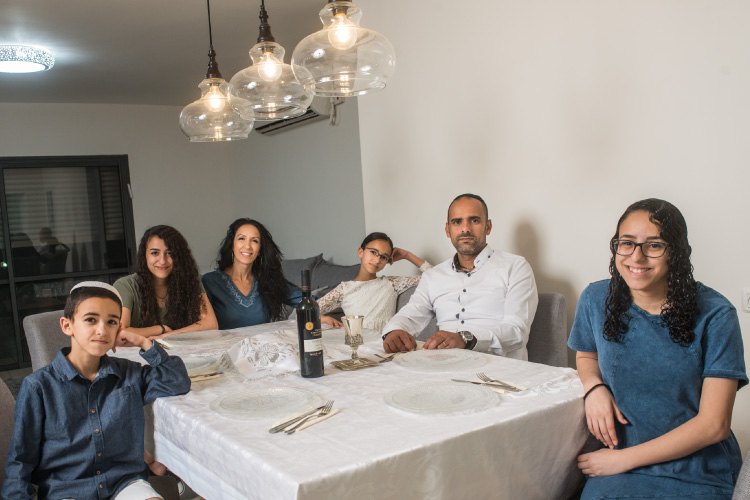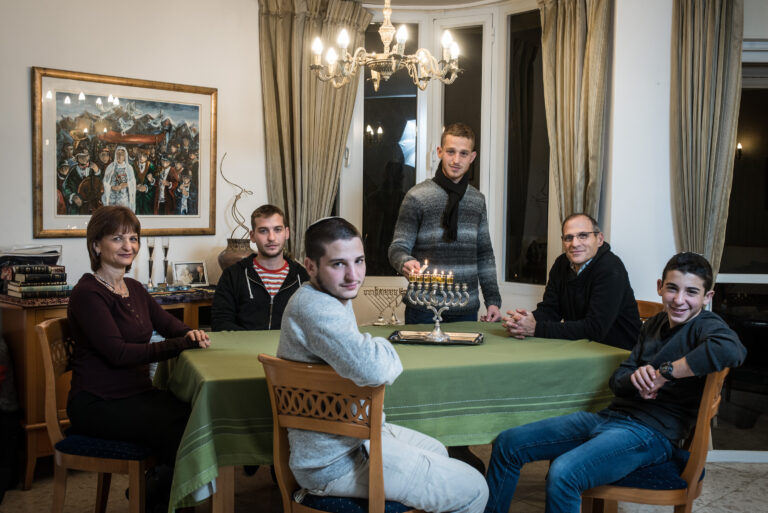
Anat and Hagai Glazner have been a couple for more than 30 years. They met at the age of 15, when they were instructors for the same troop of the Bnei Akiva youth movement, and have never been apart since. Today they have four sons, “and each one is in his own little world,” Anat says. “One is at university, the second is pursuing a career in the army, the third is studying in a ‘high’ yeshiva, and the fourth is still at a yeshiva high school. Each of them’s a role model, something special. When we all get together around the Shabbat dinner table, it’s never boring. The kids are already grown up and they all have their own opinions.”
Anat, an accountant by training, works for the Tax Authority. Hagai is VP Development at Tadiran Telecom. When their kids were small, they hired a nanny to help out – and they’re still in touch with her today. “That’s how we live our lives,” Anat explains. “We keep in contact with people.” In fact, this is also why they became a Nativ host family.
“Three years ago,” Anat says, “I had this hairdresser who was a Christian immigrant from Moldova and married to a Jewish guy. Their daughter, a lovely girl named Alex, went to school in Netanya. When she turned 12 and all the other girls in her class were celebrating their bat mitzvah, she became curious about her Jewish heritage. She’d light Shabbat candles and ask about conversion, and her mother told her: you can convert when you’re 18. After Alex enlisted in the IDF, she signed up for Nativ’s Military Program and we became her host family.”
Was it easy for you to take on this new role?
“It was no problem at all. Interestingly, at first Alex thought we couldn’t be her host family because we weren’t religious enough. She thought that only Ultra-Orthodox people from Mea Shearim were truly religious, and for example I don’t wear a headscarf. She didn’t know about the National Religious community, which is still religious in every way. Both of us, my husband and I, come from that kind of background, with families in the Hapoel HaMizrachi movement.”
So she was happy when it turned out you could support her after all?
“Of course. We became very close and hosted her a lot. At that time, she already had a boyfriend, an Israeli guy, and they’d both come to our Shabbat dinner. The boyfriend came from a secular family and the whole process inspired him to start putting on tefillin and going to synagogue. Alex successfully passed the Conversion Court. We went to the hearing with her in Jerusalem. When the rabbi asked her why she wanted to be Jewish, she replied: I want to have a family like my host family. That’s how I want to raise my kids, that’s how I want the Shabbat table to look. It was very moving.”
“Today, her name is Elia and we’re constantly in touch with her. We celebrated Rosh Hashanah and Sukkot together, we lit candles together on Hanukkah. Our whole extended family knows her and her boyfriend, not just our kids They’ve really become part of the family. They’re getting married soon.”
Did you go from being a host family to being an adoptive family?
“Not exactly. Elia still has her parents, who supported her conversion 100%, and we’re not replacing them. But by nature, we like to stay in touch even after the goal has supposedly been reached and the conversion process is complete. That’s why we don’t support that many people through the process. It’s not only about another plate at the table, it’s much more than that. It’s a real emotional connection.”
“By nature, we like to stay in touch even after the goal has supposedly been reached.”
So far, the Glazners have supported two converts. “After Elia passed the Conversion Court, Nativ called us and asked us to take on another student,” Anat says. “He was urgently looking for a new host family, after things didn’t work out with a previous family. It was right before Shavuot. I asked my husband if we were willing to take on another convert and he said that we couldn’t say no, since they called before Shavuot. Because that’s the holiday when we read the Book of Ruth, who was a convert, of course.”
So you didn’t say no.
“Right. It wasn’t even three days before we invited this guy to join us for the holiday. He came to us and it turned out he already knew a lot. A very colorful personality, the kids got on so well with him. Then we also met his Jewish girlfriend. She’s wonderful, a very warm girl. We formed a good, strong bond. We even have a very active WhatsApp group together.”
Did his process go smoothly too?
“Not really. Actually, it was extremely tough. We were worried he wouldn’t pass the Conversion Court hearing. We went with him to the court in Haifa. Before he’d begun the conversion process, he’d had a very turbulent life – both as a child and as an adult – so the judges were concerned. They weren’t sure about him and tried to examine him really deeply. They wanted to be convinced that he sincerely wanted to convert.”
Did he pass in the end?
“Yes, the judges passed on the condition that we’d support him for another six months. Since we stay in touch anyway, it wasn’t an imposition. In the end, he got there and we were thrilled to attend he and his girlfriend’s wedding. A couple of friends from our community, who were moved by their story, held a traditional Sheva Brachot meal for them at their home, as we usually do for all the sons and daughters who get married in the community.”
Would you recommend becoming a host family to other families?
“Absolutely. Each person is a world in themselves. Knowing that we helped two converts join the Jewish people is immensely satisfying. Anyone who volunteers for this important task will be blessed.”